The Cart and Horses: Where the Spirit of Iron Maiden Still Lives
- Randall Wilburn

- 5 days ago
- 11 min read
Updated: 6 hours ago

By the Fermented Metal staff | Interview conducted by editor Randall Wilburn
There is a corner in the East End of London...
...where Maryland Point meets Leytonstone Road, and Windmill Lane runs off at an angle as though unsure of itself. It is not a glamorous corner. The buses rumble past, the railway line chatters overhead, and the traffic of Stratford goes about its business with cheerful indifference to everything it passes. And yet, nestled on that corner, is a building that changed the course of rock music: a Victorian-era pub called The Cart and Horses.
Most people who know the name know it for one reason: Iron Maiden played their first proper gig here in 1976, and went on to become one of the biggest heavy metal bands in history. But that framing, accurate as it is, barely scratches the surface of what The Cart and Horses actually is today, and what it means to the community that orbits it.
Kastro, the pub’s operator, has thought carefully about this distinction. When asked how he would describe the pub’s connection to Iron Maiden in his own words, his answer reaches further than the history books:
“For many people, Cart and Horses is known as the birthplace of Iron Maiden, and that’s absolutely true — it was their first residential venue — but to me, it’s more than just where it started. It’s where the spirit of the band still lives. You can feel that raw energy, that early hunger, and that connection to the fans in a very direct way. It’s not a museum piece, it’s still alive.”
Kastro
That insistence on aliveness — on the pub as a living organism rather than a framed photograph — is the first thing to understand about The Cart and Horses. The second is that its story begins long before Steve Harris ever plugged in a bass.
A House of Ale Since 1765
The name ‘Cart and Horses’ has been on this stretch of East London since at least 1765, making it one of the older drinking establishments in the area. By around 1805 the pub had settled into its current footprint at Maryland Point, and in approximately 1880 the building was substantially rebuilt — giving it the solid, no-nonsense Victorian bones it still wears today. It is a proper London boozer: all sturdy brickwork, frosted glass, and the quiet dignity of a place that has watched decades pass from behind its bar.
For generations it served the working-class community of Stratford and the surrounding streets of Newham, a borough that has never been short of graft, noise, or character. It was the kind of pub where dockers rubbed shoulders with factory workers, where the end of a long shift meant something cold in a glass and a moment’s peace. Nothing about it, in those early years, suggested it would one day be spoken of in the same breath as the Marquee Club or the Cavern.
But history, as any metalhead will tell you, has a way of arriving unannounced, guitar in hand, wanting a residency.

The Beast Takes Up Residence: 1976–1978
In 1975, a young bassist from Leytonstone named Steve Harris formed a band. He had been playing around with the idea for a couple of years, inspired by the twin guitar attack of Thin Lizzy and the theatrical bombast of Wishbone Ash, as well as a burning personal compulsion to write epic, narrative-driven heavy music. He called the band Iron Maiden, after a medieval torture device he had seen in a film. The name suited them.
The Cart and Horses was where that ambition met the world. On 9 June 1976, Iron Maiden took to the small stage of this East End pub for what Harris himself has called their first ‘proper’ gig. Not a rehearsal. Not a friends-in-a-garage session. A proper gig, in a proper pub, in front of a proper crowd. The date is now effectively consecrated in heavy metal history.
By December of that year, the band had welcomed a second guitarist: a young man from Hackney named Dave Murray, who made his debut with Iron Maiden on the 21st of December 1976 — again at The Cart and Horses. The pub, whether it knew it or not, was becoming the incubator for something extraordinary.
"The place was mobbed every time they played there — crowds queuing down the street, many having to be turned away."
Through 1977, Iron Maiden made The Cart and Horses their home. They played there on an almost weekly basis, building a devoted local following with a ferocity and tightness that was rapidly setting them apart from the pub rock scene around them. The pub’s punters — many of them locals with no particular prior interest in heavy metal — found themselves converted through sheer force of presence. Word spread. Queues formed outside on the street. People were turned away at the door.
It could not last forever in quite that form. Trouble at a gig on 23 May 1977 resulted in the band’s enforced exile from the venue. Iron Maiden did not return until 7 April 1978, for a single, bittersweet night that would prove to be both the penultimate gig of singer Dennis Willcock and the final time Iron Maiden ever played the venue. Within months they had moved on to bigger stages and a recording career that would carry them to arenas across the globe.
The connection, however, never fully severed. Steve Harris still comes back — not in the capacity of a rock star returning to take a bow, but as a musician who simply loves the room. His side project, British Lion, play the pub to this day. Kastro recalls what Harris has said about the experience.
“Steve always said that it feels like he never left, even after almost fifty years of not playing here. That tells you everything about what this place means to him.”
Kastro
That continuity — the sense of an unbroken thread running from the first gig in 1976 to last Saturday’s basement show — is perhaps the most remarkable thing about The Cart and Horses. Most historic venues either become tourist traps or fall into disrepair. This one kept playing.

Not a Museum. Not a Tourist Stop. A Pub.
The question of what separates The Cart and Horses from a ‘music history’ pub — one of those establishments that trades on association with a famous name while quietly hollowing out everything that made it interesting — is one worth asking directly. Kastro’s answer is immediate and precise:
“I think the key difference is that we’re not trying to recreate history, we are part of it. This is still a working pub, with live music, real atmosphere, and a community. You’re not walking through something staged; you’re stepping into a place where things genuinely happened and are still happening.” Kastro
This distinction matters enormously to the fans who make the journey — and they do make the journey, from every corner of the world. The pub sits just fifty yards from Maryland station on the Elizabeth line, eminently accessible from almost anywhere in London. Pilgrims arriving from Tokyo, from São Paulo, from Stockholm, from Sydney, are not confronted with a heritage plaque on a boarded-up building. They walk into a working pub: the smell of ale, the sound of conversation, Iron Maiden memorabilia covering the walls, and most evenings, live music rising up from the basement below. Kastro is disarmingly frank about the weight that comes with that:
“It’s a real privilege, and something I don’t take lightly. We regularly have fans visiting from all over the world, and for many of them, this is a pilgrimage. Being part of that experience, giving them a place where they can feel close to the band’s roots, is incredibly special. There’s a responsibility there to keep it authentic and to keep going.” Kastro
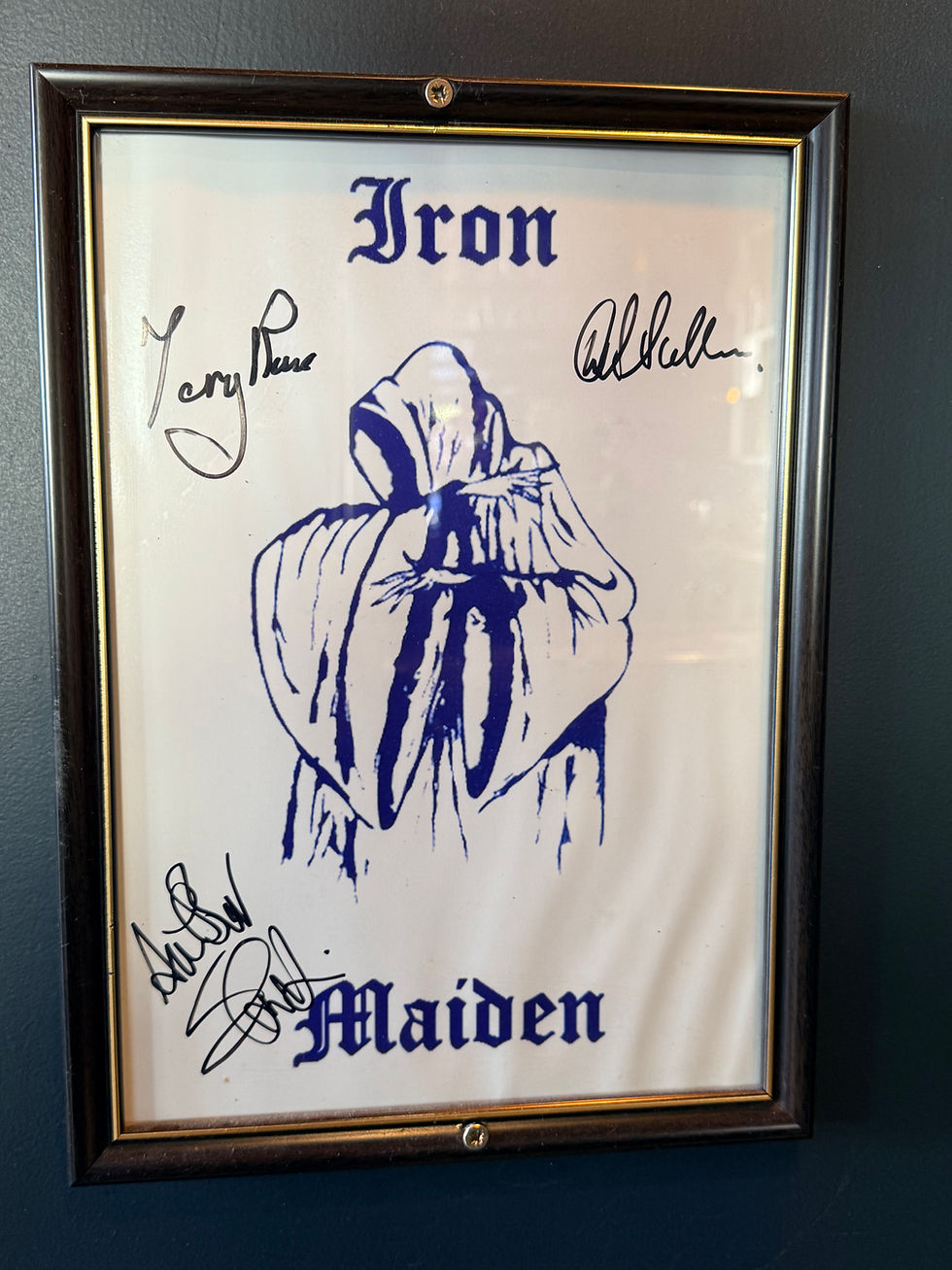
Everything Comes Full Circle: Robinson’s Brewery and the Trooper Legacy
If Iron Maiden forged The Cart and Horses’ immortal reputation in the 1970s, then the band’s partnership with Robinson’s Brewery — one of Britain’s most respected independent family breweries, based in Stockport — gave that legacy a liquid form that any fan could hold in their hand.
In 2013, Iron Maiden and Robinson’s Brewery launched Trooper: a Premium British Ale co-created by Bruce Dickinson — the band’s frontman, and a vocal enthusiast of real ale — alongside Robinson’s Head Brewer Martyn Weeks. Dickinson threw himself into the project with the same energy he brings to everything else, making regular visits to the Stockport brewery to develop the flavour profile. The result was a beer named after one of Iron Maiden’s most beloved songs: a well-balanced, golden ale with a crisp hop character and genuine drinkability.
The collaboration has expanded enormously in the decade since. The range now encompasses a growing family of beers — among them Fear of the Dark, a 4.5% English stout; Sun and Steel, a double-fermented lager brewed with authentic Japanese sake yeast; and a sessionable Trooper Pale Ale. By 2023 — the collaboration’s tenth anniversary — over 35 million pints had been sold in more than 68 countries.
The Cart and Horses always has the latest Trooper in stock. But Kastro is clear that the relationship between the pub, the band, and the beers is something more organic than a simple retail arrangement.

“The relationship today feels very natural. Iron Maiden has built an incredible global legacy, and the Robinsons beers are an extension of that — another way fans can connect with the band. Cart and Horses sits at the origin point of that story, so when people enjoy those Trooper beers here, it feels like everything comes full circle.”
Kastro

There is something deeply satisfying about that symmetry: the pub where the band was born, now serving the beer that bears their name. But the connection is not merely symbolic. According to Kastro, the beers actively function as a bridge between the pub’s heritage and the fan experience.
“The connection happens in a very organic way. Fans come in already aware of the beers — sometimes asking if we have any new Trooper — and when they’re able to enjoy them in the environment where the band began the journey, it adds another layer to the experience. It’s the stories, the photos, the music playing — it all brings it together in a way that you can’t replicate elsewhere.”
Kastro
To sit in The Cart and Horses with a pint of Trooper is to close a loop that began on a small stage in 1976. It is the sort of poetic continuity that you could not invent and would not dare to.
The Emotional Moment
Kastro has watched the meeting of place, beer, and history produce genuine emotional responses in fans who had perhaps not anticipated quite how affecting a pub visit could be.
“One thing that always stands out is seeing fans’ reactions when they realise where they are, especially when they’re holding a Trooper in the very place of Iron Maiden’s first residency. There’s a real moment of connection there. We’ve had people get quite emotional, which says a lot about what the band — and by extension the Cart and Horses — means to them.” Kastro
It is a particular kind of emotion: not grief, not nostalgia exactly, but something closer to recognition. The feeling of standing in a real place where a real thing happened, and understanding, perhaps for the first time, that history is not an abstraction.
The Wasted Years: Pandemic, Peril, and Resurrection
The Cart and Horses has survived economic upheaval, the demolition of the surrounding neighborhood, and the indifference of passing decades. But it nearly did not survive the COVID-19 pandemic.
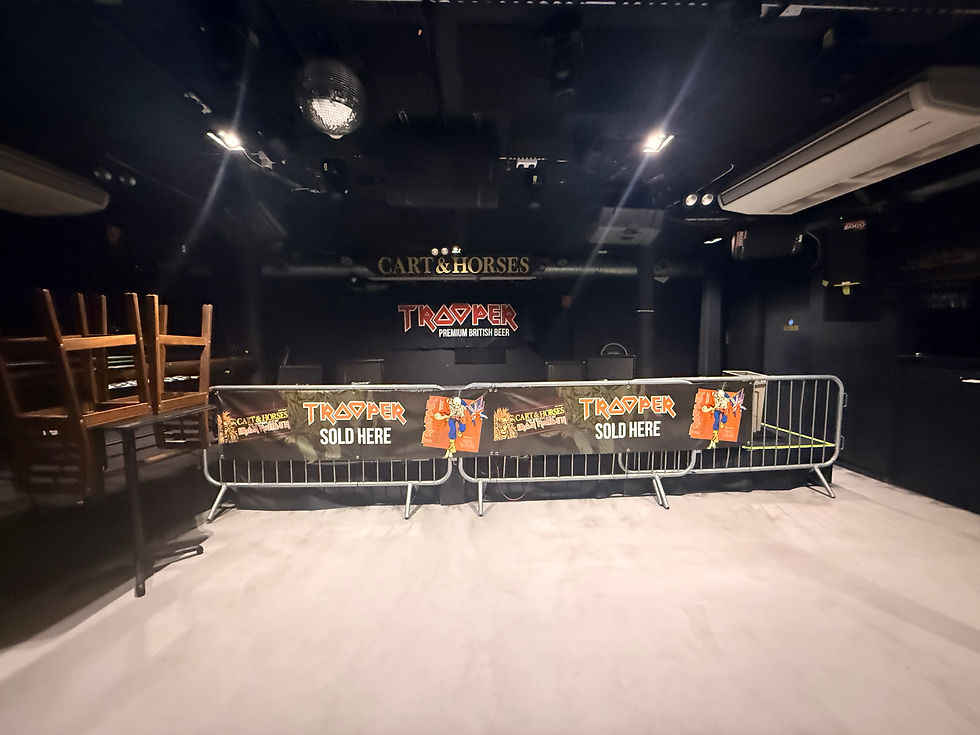
By June 2019, the pub had been undergoing a major refurbishment — a bold project to transform it into something that could honor its heritage while serving a new generation. The centrepiece was an ambitious renovation of the vast basement: the plan was to dig down 1.2 metres and create a purpose-built live music venue accommodating around 80 people, complete with a dedicated stage, band dressing rooms, and its own bar.
Then the pandemic hit, and the world stopped. With pubs shuttered and live music an impossibility, the refurbishment stalled, income evaporated, and the future of The Cart and Horses became genuinely uncertain.
The response from the Iron Maiden family was immediate. Former members of the band spanning virtually every era of the group’s history rallied around the pub. Three former singers (Blaze Bayley, Paul Di’Anno, and Paul Mario Day), three former guitarists (Tony Parsons, Terry Wapram, and Terry Rance), three former drummers (Doug Sampson, Barry ‘Thunderstick’ Purkis, and Ron ‘Rebel’ Matthews), and the band’s original keyboardist Tony Moore all donated rare and exclusive tracks to a fundraising compilation.
The resulting CD — titled Cart & Horses: Wasted Year 2020 — was released with every penny of profit going directly to the pub. A second volume followed. The proceeds paid for the new stage that would anchor the basement venue. It was an act of collective solidarity that said something profound about the bonds formed in that pub half a century earlier.
The Cart and Horses survived. After reopening over a landmark weekend — with performances from artists across the Iron Maiden family tree — the pub unveiled its new basement live music space: an 80-capacity room that is now one of the finest small metal and rock venues in East London. Steve Harris’ British Lion have played the venue, bringing the circle from founding gig to modern homecoming fully around.
More Than a Pilgrimage: The Pub, the Pint, and the Community
There is a broader truth operating at The Cart and Horses that goes beyond Iron Maiden specifically. For the metal community, the pub has always occupied a particular place in the culture. Not the nightclub, not the concert hall — the pub. The metal pub is a democratic institution: everyone is welcome provided they behave, the drink is the same for everyone, and the music belongs to whoever turns up. In a genre built on the energy of the working class and the excluded, the pub was and remains the natural home.
The Cart and Horses embodies that tradition with particular force, because its very origins are the story of working-class East London lads playing heavy metal in a pub and, through sheer talent and determination, making the world take notice. Steve Harris grew up in these streets. The men who filled those queues in 1977 were not industry insiders or tastemakers. They were the neighbors. They were the regulars. And they recognized something real.
The pandemic fundraiser illuminated something that those of us who love heavy metal have always known but seldom articulate so clearly: the metal world looks after its own. When The Cart and Horses was in danger, former members of Iron Maiden did not wait to be asked. Musicians who had not played together in decades gave their music freely so that a pub in Stratford could pay its bills. The fans bought the CDs. The community held.
Looking Forward
The question of what The Cart and Horses means to the future — not just to the past — is one that Kastro has clearly thought about. His answer, characteristically, refuses the nostalgic framing and pushes forward.
“I’d want people to understand that Cart and Horses isn’t just about looking back, it’s about continuing the journey. Yes, it’s a historic place, but it’s also a venue that still supports live music and keeps that original spirit alive. If you’re a metal fan coming to East London, this isn’t just a stop on a map, it’s an experience, and you’re helping to keep the history alive.”
Kastro
That framing — the visitor not as tourist but as active participant, as someone whose presence keeps a living tradition alive — captures something important. The Cart and Horses is not a monument. It is a relay, passing its spirit from one generation to the next, through music and beer and the simple act of showing up.

If you have not been, go. Take the Elizabeth line to Maryland, walk the fifty yards, and push through the door. Order a Trooper — cask if they have it — and take a moment to look at the photographs on the walls: a young Steve Harris holding down the low end on a stage barely bigger than a kitchen table; the crowds that queued in the rain to get in; the faces of musicians who had no idea they were making history but were doing it anyway.
Then go downstairs. Find out who’s playing. Buy a ticket. Stand near the front.
The Cart and Horses has been doing this for over two and a half centuries: providing a space where people gather, where drink is shared, where music happens, where community is made. Iron Maiden spent two years here and left it changed forever. Robinson’s Brewery gave it a beer worthy of its name. The metalhead community gave it back its future when the future looked dark.
The pub is a living thing. And it is very much alive.

The Cart and Horses | 1 Maryland Point, Stratford, London E15 1PF | Open daily from 12pm | cartandhorses.london

Comments