Issue No. 001 · Inaugural Edition · APRIL 2026
Heavy METAL x Fermentation X FAN Culture
Fermented Metal explores the cultural intersection of heavy metal music and the worlds of brewing and distilling. Through interviews, features, and on-the-ground reporting, we document the artists, brewers, distillers, and fans who keep these loud and flavorful communities thriving.
FERMENTED IN FIRE
Heavy metal’s decade-long booze boom produced beloved brands, quiet failures, and a blueprint for what craft collaboration can actually look like. Where are we at today?
BY STAFF · FERMENTED METAL MAGAZINE · APRIL 2026
In a rickhouse somewhere...
... in the American whiskey belt, a row of bourbon barrels sits stacked in the dark. A battery of subwoofers—black, road-worn, the kind of gear a touring band would recognize—is pointed at the staves. When the programmable playlist kicks in, the barrels pulse. Not metaphorically. Physically. The low frequencies of Metallica’s catalogue, played loud enough to shake the wood, agitate the finished whiskey against the char. This is not a publicity stunt, although the marketing department is happy to let you believe it might be. It is the actual finishing process for Metallica’s Blackened whiskey, a brand that has, against the odds of novelty-licensing conventional wisdom, become one of the most credible craft spirits of the last decade.
It has also become the most visible exhibit in a wider phenomenon that, since 2013, has turned heavy metal into one of the most reliable business partners that craft fermenters have. Beer, wine, whiskey—if it ferments, someone has put a pentagram on it. And for every Blackened or Trooper, there is a discontinued SKU gathering dust in a regional distributor’s warehouse, a reminder that the formula is not as simple as logo + liquid = sales.
The genre that built its aesthetic on darkness, volume, and authenticity turns out to have an unusually strong set of shared values with the craft fermentation world. Both worship process. Both are suspicious of the mainstream. Both prize the small-batch, the ritual, the obsessive. But the collaborations that have survived a full album cycle—let alone a full decade—share something else, too: an actual artist in the room, and an actual producer who gives a damn about the liquid.
THE BENCHMARK
When Iron Maiden released Trooper in May 2013 through the family-run Robinsons Brewery in Stockport, England, the deal looked, on paper, like every other novelty beer deal of the era. A legacy band with an aging fanbase. A regional brewery hoping for a volume boost. A bottle labeled with Eddie astride a galloping horse. The expected trajectory: a six-month pop, a year of declining reorders, and then the slow fade to retail irrelevance.
That is not what happened.
Bruce Dickinson—pilot, fencer, cancer survivor, and, as it turns out, a credible amateur beer enthusiast—worked on the recipe directly with Robinsons’ brewing team. The resulting beer was a session-strength premium bitter at 4.7 percent ABV, balanced toward honey and citrus rather than the aggressive hop-forward profile that was already becoming the craft beer standard. The early production run sold out in weeks.
By May 2024, according to Robinsons and industry coverage in The Drinks Business, Trooper had sold more than 30 million pints in 60 countries. Robinsons now produces a growing Trooper family—Trooper 666, Sun and Steel (a sake-infused lager), Fear of the Dark (a stout), Hallowed (a Belgian), Red ’N’ Black (a porter), and the 10th-anniversary Trooper X pale ale—and the brand has sustained itself across multiple countries, multiple distributors, and an entire generation of metalheads who have aged into the demographic that buys cases rather than singles.
Trooper is the benchmark not because it is the most sophisticated collaboration in the space—it is not—but because it was the proof of concept. It demonstrated that a metal-branded beer could outlive the hype cycle, that a band could be a real recipe collaborator rather than a logo hire, and that the craft drinker and the metal drinker were, more often than the industry realized, the same person.
THE SOPHISTICATION
If Trooper was the benchmark, Blackened was the sophistication.
Launched in September 2018, Blackened was the final project of Dave Pickerell, the former Maker’s Mark master distiller who had earlier engineered WhistlePig’s rye renaissance. Pickerell died on November 1 of that year, only weeks after the whiskey reached market. He had called it, in interviews published by Revolver and the Bourbon Review, his true legacy. The project was not a vanity collaboration. Pickerell had pitched the band on a rotating blend of American whiskeys, finished in black brandy casks, with the final maturation stage put through a proprietary sonic enhancement process he called the Black Noise.
The Black Noise is where the project separates itself from its peers. Each batch of Blackened is finished in a rickhouse wired with low-frequency transducers, playing a band-curated Metallica playlist into the staves. The company’s published theory is that the sub-bass vibrations agitate the liquid inside the cask, increasing the surface contact with the charred wood and accelerating extraction. Critics in the spirits press have expressed skepticism about the magnitude of the effect. Few have disputed that the resulting whiskey is, at minimum, a genuine craft product.
Pickerell’s successor Rob Dietrich, formerly master distiller at Denver’s Stranahan’s, expanded the Blackened line after taking over. Blackened Rye, the Lightning, single barrel releases, and a Masters of Whiskey Series of collaborations—its first release, Blackened x Willett, is a cask-strength Kentucky straight rye finished in madeira casks, blended from Willett Family Estate rye and produced with Willett master distiller Drew Kulsveen—now anchor the brand. The flagship sits at a suggested retail price around the mid-forties. Limited releases have fetched considerably more on secondary. By volume Blackened is small compared to Trooper. By margin and by critical reception, it has become the model that everyone else wants to emulate.
That is a problem for everyone else.
THE MIDDLE CLASS
Between the Trooper model—mass-market craft partnership with a regional brewery—and the Blackened model—artisanal spirits with a band that can bankroll its own barrels—sits the bulk of the current metal-fermentation landscape: the middle-tier collaboration. These tend to be limited releases, festival drops, anniversary editions, and one-off recipe partnerships with respected craft brewers. They are where most of the actual creative work is happening, and where the margin between “successful” and “quietly discontinued” is thinnest.
Mastodon’s long relationship with Mikkeller, the Danish nomadic-brewing outfit, is the most durable of these. The pair have produced a rotating slate of limited releases—Mother Puncher, a Brettanomyces-fermented IPA with passion fruit first released in 2015; Sultan’s Curse, a bourbon-barrel-aged imperial stout brewed with dates, toasted pistachios, and cardamom, released in 2018; and the Czech pilsner Ancient Kingdom—that have moved through Mikkeller’s global bar network and stayed in sporadic rotation for close to a decade.
Amon Amarth have worked with two very different breweries in two very different registers: Three Floyds of Munster, Indiana, on a strong porter called Ragnarök, and later Bitburger on the limited-edition Simcoe-hopped export lager Nordic Gold, released around 2022. The Three Floyds collaboration in particular delivered the malt-forward weight that matches the band’s Viking iconography.
Behemoth’s work with the Polish craft brewery Perun produced the Belgian-style Sacrum (6.2 percent ABV, 2015) and the American amber Heretyk; the band later crossed the Atlantic to brew the double IPA Wolf ov Siberia with Brooklyn’s Kings County Brewers Collective. Municipal Waste, who treat beer as brand DNA rather than as side hustle, brewed the Toxic Revolution oatmeal stout (8.5 percent ABV) with Three Floyds in 2013, and followed it with the Divine Blasphemer porter at Cigar City in Tampa. Kvelertak, the Norwegian metal-punk band, have sold their own-label beer at European tour stops since at least 2011. The list of surviving, respectable, repeatable collaborations is longer than the casual drinker would guess.
The common denominator is not genre loyalty. Some of these pairings cross fermentation cultures wildly—sludge-metal bands on hazy IPAs, thrash bands on pilsners. The common denominator is a specific kind of creative seriousness. When a band member can talk with genuine fluency about Saccharomyces pastorianus versus cerevisiae, or about the the difference between a rye mash bill at 51 percent versus 95 percent, the collaboration tends to produce something worth drinking. When they cannot, it does not.
THE GRAVEYARD
Which brings us to the “failures,” which are not small in number.
Slayer’s Reign in Blood Red, a California Cabernet Sauvignon named for the band’s 1986 album, was first introduced in 2012 as a 2010 vintage and is currently produced by Cypher Winery in Paso Robles. The liquid, by the accounts of wine writers who reviewed it, has been competent throughout. The commercial project, however, lost its biggest sell-through driver when Slayer concluded its farewell tour in 2019. Distribution has ridden an inconsistent arc since.
Megadeth’s À Tout le Monde Belgian Saison, brewed in collaboration with Unibroue and released in 2016, had legitimate craft credentials—Unibroue is one of North America’s most respected Belgian-style producers—and moved significant volume in its initial release window. A 2019 follow-up, Saison 13, extended the line but has not itself become a perennial. Motörhead’s Shiraz, produced in southeastern Australia by Broken Back Winery and launched in 2010 on Lemmy Kilmister’s personal initiative, has outlived the band’s frontman but operates, in the post-Lemmy era, as a licensed estate wine rather than as a living collaboration. AC/DC’s wine portfolio with the Australian Warburn Estate, launched in 2011, has had a more stable run but operates more as straightforward celebrity licensing than as a collaboration with creative input.
At the lower-profile end, the graveyard is larger still. Anthrax’s Wardance pale ale with Butternuts Beer & Ale (2014) was named for a line from “Indians,” moved through the Northeast on the back of an enthusiastic rollout, and is no longer in production. Pig Destroyer’s Permanent Funeral double IPA, a genuine cult collector at 10.5 percent ABV, moved on the strength of a perfect-score RateBeer reception and never really became available in the way that a reliable product needs to be. Hatebreed’s long-running Breedbrew line with Connecticut’s Witchdoctor Brewing, which survives as one of the few independent-metal beer programs with a coherent portfolio, is an exception rather than the rule. Most of the others—one-time festival exclusives, anniversary releases tied to album cycles, tour-market drops that were never meant to have a second pressing—are either out of circulation or distributed on a basis that is effectively equivalent.
The pattern in the failures is instructive, and repeats regardless of subgenre: a licensing deal rather than a collaboration, a fermenter chosen for volume rather than fit, a band whose own trajectory was already past its commercial peak, or—in the worst cases—a liquid that simply was not good enough to justify a return purchase at the price the branding commanded.
THE MECHANICS
The economics underneath this category have shifted meaningfully since Trooper’s 2013 launch. A decade ago, the prevailing model was a conventional licensing deal: a band’s management company licensed the brand, a fermenter wrote a royalty check, a designer did a label, and a limited run went to retail. The band’s involvement, if any, was a photo shoot and a press release. The margin looked attractive until the second-year reorders did not materialize.
The current model, in the collaborations that are working, looks much more like how craft fermenters collaborate with each other. The band member or members who actually care about beer, whiskey, or wine—and this set is not small; Dickinson, Scott Ian of Anthrax, Nergal of Behemoth, and various members of Mastodon and Municipal Waste, among others, have well-documented personal involvement in fermentation—are in the room for recipe development. The band’s equity in the product is often real equity, not a royalty. Distribution is handled by the fermenter’s existing network, which means the product is shelved alongside other craft product rather than in the novelty aisle. Pricing respects the fermenter’s existing tier.
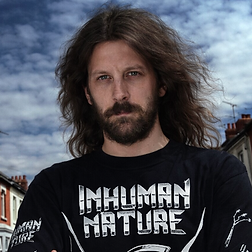
Bruce Dickinson photo provided by Rees Croasdell: Robinsons Brewery Visitor Centre Ambassador
Blackened is the clearest example of this model taken to its logical endpoint. The product is owned by Sweet Amber Distilling, the band’s own spirits company, rather than licensed to an outside brand. The company controls the mash bill, the finishing, the marketing, and the pricing. The band is the ownership. Trooper operates closer to the classical model but has been unusually successful because Robinsons treats it as a flagship rather than a sideline, and because Dickinson continues to show up.
A third model has begun to emerge: the direct-to-consumer, members-club release. Bands with sufficiently committed fanbases—and a back-catalogue of limited releases worth collecting—are increasingly bypassing traditional distribution. Blackened’s batch releases and the allocations it sends direct to its mailing list are the most prominent example. Kvelertak and a handful of European metal acts have experimented with similar limited-allocation models through European craft networks. The implication is that the future of the category may not look like the shelf at a big-box liquor store. It may look like the mailing list for a highly specific subculture, with a few big commercial exceptions at the Trooper and Blackened tier.
WHAT YOU ARE ACTUALLY DRINKING
Strip out the branding, the aesthetic, the logos that scowl back at you from the bottle, and a fair question remains: is the liquid good?
The honest answer, across the category, is that it varies more than fans want to admit and more than detractors want to concede. The best products in the category would be good products without the branding. Blackened’s whiskey holds up under a blind tasting against craft American whiskey at its price point, and its Masters of Whiskey Series releases have drawn coverage in Whisky Advocate on their merits. Trooper is a competent premium bitter that would survive a CAMRA evaluation without the Eddie label. The Mastodon–Mikkeller releases have earned serious scores on the major beer-rating platforms. Behemoth’s Sacrum held its own in Polish craft beer press. These are not charity scores.
The worst products in the category are novelty liquid with novelty prices, trading entirely on the merch-table impulse purchase. The listener who buys one of these with high expectations is the listener who gets turned off the category for life. That is a long-term problem for everyone operating in the space: a bad first bottle from one band sours the customer on the next band’s good bottle.
The middle of the category—which is most of it—is pleasant-to-good product that is perfectly worth drinking at the fair price and perfectly dismissible at the hype price. Festival drops and tour-market releases typically fall here. That is not a scandal. That is, arguably, exactly the role a limited-edition collectible beverage should play in a fan’s year. It is a scandal when the pricing does not match.
WHAT IT MEANS
The thing that is easy to miss from outside the genre is that this is, as cross-industry collaborations go, healthy. Heavy metal and craft fermentation are two subcultures that, on the surface, share an aesthetic—black labels, baroque typography, a fondness for imagery that would alarm your grandmother—but actually share something more durable: a shared worship of process, small-batch attention, and the willingness to pay—and charge—a premium for it.
Prost! ¡Salud! Skål! Cheers! Skål! 乾杯!
For the musicians, a working fermentation partnership is a revenue line that does not depend on streaming economics. The loyalty of the metal listener, whose median willingness to buy a physical object attached to a band they love remains stubbornly high in a market where that willingness has collapsed almost everywhere else, translates cleanly to willingness to buy a bottle. For the fermenters, access to a subculture with a well-documented consumption habit and strong brand attachment is a growth lever that does not require national advertising. For the drinker, in the best case, it is a genuinely interesting bottle, a meaningful connection to a band they love, and a reason to pay attention to a small fermenter they otherwise would not have found.
The category is now mature enough that it is starting to weed itself.
The cynical licensing plays are getting called out faster,
by a fanbase that is not naive. The novelty prices are getting rejected